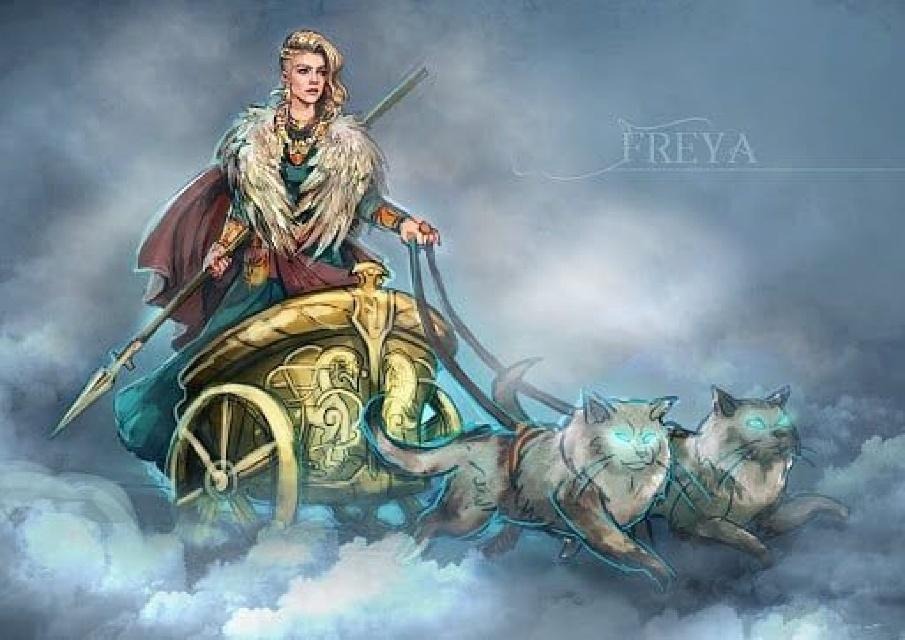
According to legend, two Norwegian Forest Cats pulled the Norse goddess Freya’s chariot as she traveled the heavens. These cats were so large and powerful that even Thor could not lift them.
Norwegian Forest Cats, called Skogkatt (forest cat) in Norway, are an ancient, natural breed that developed to survive harsh winters in Norway and other Scandinavian countries. They were known for their climbing and rodent-hunting skills, particularly in countryside barns and on Viking ships. They may have first arrived in North America with Leif Erickson or his contemporaries in the late 900s.
Norwegian Forest Cats are relatively large (average 15 pounds), long-hair cats with a straight nose profile, equilateral triangle-shaped head, double coat, long back legs, medium-sized ears, and a slightly wild look. The profile of the nose is straight from the ridge of the brow to the tip of the nose. The face forms an equilateral triangle from the outer base of the ears to the chin. The outer coat is longer, coarser, and water-resistant. The undercoat provides insulation to keep them warm in the cold winters of Norway. The back legs of Norwegian Forest Cats are somewhat longer than the front legs and the front legs “toe out,” which enables them to climb up and down trees. The medium-sized ears have lynx tips (tufts of hair). Norwegian Forest Cats have a ruff and collar around their chest and neck, a sturdy body, and a bushy tail, all of which gives them a wild look.
Despite the wild look, Norwegian Forest Cats are playful and cuddly. They actually like their human companions, including children, as well as their canine companions.